

Sacred Circle of Unity
UFCW Locals 175 & 633 is committed to advancing Indigenous Reconciliation, Advocacy, and Treaty Recognition.
The artwork by artist Philip Cote, called Sacred Circle of Unity, is on display at the Local Union’s head office in Mississauga. The mural is a result of a UFCW partnership with the Indigenous-led group called Moccasin Identifier™. This group is dedicated to connecting all Canadians with a deeper understanding of Reconciliation and Treaty Recognition through symbolic art, education, and public awareness campaigns.
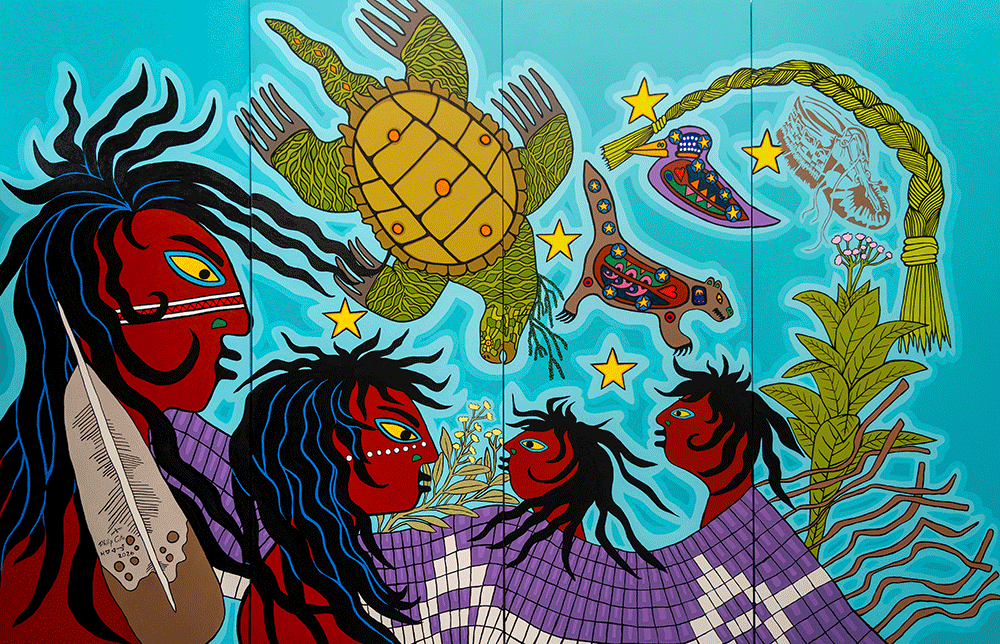
Philip Cote, 2026
Cote’s mural, installed at the Local Union’s Mississauga office, was unveiled on April 15, 2026, to an audience of Executive Board members and staff.
About the mural
“This thing is really important because this is part of the Truth and Reconciliation. This is why it’s all happening,” said artist Philip Cote. “This is why the union decided that they needed some representation of Indigenous people on their property.”
The mural, titled the Sacred Circle of Unity, looks at the interconnection of family, spirituality, and the earth through an Indigenous perspective. Through symbolism, colour, and storytelling, the mural captures the time of the Eighth Fire and the pathway to heart-thinking.
“We wanted this mural to anchor the entryway to our offices here to ensure that anyone who enters our space understands our commitment to those principles and to the spirit of Reconciliation,” said President Kelly Tosato. “We understand it is our responsibility to acknowledge that our offices, our staff, and our members live and work on the unceded territories of many First Nations, Métis, and Inuit people. We take that responsibility seriously and we continue to pledge to do our part in raising awareness and advancing Reconciliation, working with groups like the Moccasin Identifier and the First Nations Child & Family Caring Society, and taking an active role in dismantling existing racist and classist systems that continue to harm Indigenous people.”
Eighth Fire
The Eighth Fire comes from the Anishinaabe people whose stories speak of a reconciliation and peace in the modern era. The White Bear is said to be a symbol of that Eighth Fire, and its presence is a sign of things to come. On the mural, the White Bear is represented with braided sweetgrass, which represents the power and medicine of the north.
The black lines surrounding each image represent the beginning of the universe.
The mural also depicts sage to represent the west. Sage is a powerful protection and blocker of bad energy and is connected to the Buffalo. It is used in Sun Dances and people will often fill a Sun Dance Arbor to protect those doing spirit work.
Tobacco represents the east, and with that, it also represents water and the turtle. Tobacco itself is a sacred item that Indigenous people often use for ceremonial purposes as an offer to and spiritual connection with the Creator.
The cedar represents the south and is another deeply meaningful medicinal plant that offers protection, healing, and strength. Cedar is also connected to the Thunder beings and eagles.
Cedar, sweetgrass, sage, and tobacco are considered sacred plants.
Turtle
The turtle features prominently in Cote’s artwork and it represents where we live right now – on Turtle Island – and the 13-moon calendar. Specifically, this is a snapping turtle, which has 13 spaces on its shell representing the 13 moons of the year and 28 segments around the outer edge. And 13 times 28 then represents 364 days of the year.
“I think it’s one of the few creatures out there in nature that talks about those cycles,” said Cote. “And, the Indigenous people and their wisdom saw the connections between the spaces on the turtle’s back and the number of moons there were.”
Wampum Belt
Cote’s artwork depicts the Yellowhead Wampum Belt, which represents the peace that happened after the big war in southern Ontario in the late 1600s. Each of the five diamonds on a Yellowhead Wampum Belt represents a fire and those fires represent five communities along the Great Lakes. This belt has 11 rows of beads (wampum) with a central row running through each of the diamonds. The beads on the belt represent two animals: the purple beads represent the quahog, and the white beads represent the whelk.
These two animals, who are deadly enemies, represent the delicate balance of peace. They became a symbol of friendship and peace because of the effort required to make peace happen. The purple and white are healing colours.
Wampum (the beads), which were labour intensive to make, were a form of currency long used by Indigenous communities in treaty-making and to exchange for goods. And Wampum was one of the items quickly exploited by Settlers.
Red Ocher & Faces
The skin colour of the family depicted in the mural is red ocher, which was used to mark many Indigenous pictographs and petroglyphs. Red ocher tells the story of medicine and of the earth, and represents a particular timeline.
“They would paint that red ocher on top of the symbol so that they would be either etching into the stone or painting on top of the stone,” said Cote. Cote added that Indigenous artist Norval Morrisseau told him that “the reason why they use that colour is because that is the Creator’s medicine. That colour represents the connection to the Creator. So, when they were painting those symbols with it, they were painting the story to tell to the Creator.”
These symbols can be found in many places like Petroglyph Park. And while, at one time, these kinds of symbols may have all been painted with red ocher, the colour disappeared because “they kept the place hidden so long that they let the peat moss grow over top of all the stones. And the only people that could find that place where the medicine people taking their followers out there to go and do their vision quests,” said Cote.
The other colours Cote used on the faces of the family are also important. The blue around the eyes represents the moon and the universe, and the sky that always leads the way. The green of the nostrils represents a special kind of blood in the body and purity, with some babies having the colour painted on their lower backs at birth. The white marks on their faces represent the Creator’s mark.
Eagle Feather
Depicted on the person on the far left, the eagle feather represents the highest aspirations of an individual. A leader only receives an eagle feather once their community recognizes something extraordinary about that person.
Fisher and Loon, and the Seven Grandfathers
Within the fisher depicted in the centre of the third panel is the Big Dipper constellation. And its seven stars, including the North Star which guided people on their journeys. represent the Seven Grandfathers:
- the Eagle represents Love;
- the Buffalo represents Respect;
- the Beaver represents Wisdom;
- the Bear represents Courage;
- the Raven represents Honesty;
- the Wolf represents Humility;
- the Turtle represents Truth.
Inside the loon depicted just above the fisher, is the Little Dipper constellation. And the remaining larger stars and aura around each depiction represent the wisdom of the people and the animals.
Stars are road maps, helping people travel safely in the right directions. And along with the 13 moons during the year, the shifting stars in the night sky also indicated the changing of seasons as well, helping communities know when to plant crops, harvest, and hunt.
About Philip Cote, Artist
Philip Cote, MFA of Moose Deer Point First Nation is a Young Spiritual Elder, Indigenous Artist, Activist, Educator, Historian and Ancestral Knowledge Keeper. Philip is a graduate of OCAD University’s Interdisciplinary Art Media and Design Masters program.
He is engaged in creating opportunities for art-making and teaching methodologies through Indigenous symbolism, traditional ceremonies, history, oral stories, and land-based pedagogy. His art and teaching philosophy evolves from his practice of experiential learning and the transmission of Indigenous Knowledge.
Philip has shared his knowledge with numerous institutions from York University, the Art Gallery of Ontario, University of Toronto, OCAD University, Peel District School Board and the TDSB.
As a tour guide with “First Story” since 2005, Philip provides an Indigenous history of Toronto covering the last 13,500 years and as far back as 130,000 years.
Philip has won numerous TABIA awards for his public Street Art Murals Across the City of Toronto.
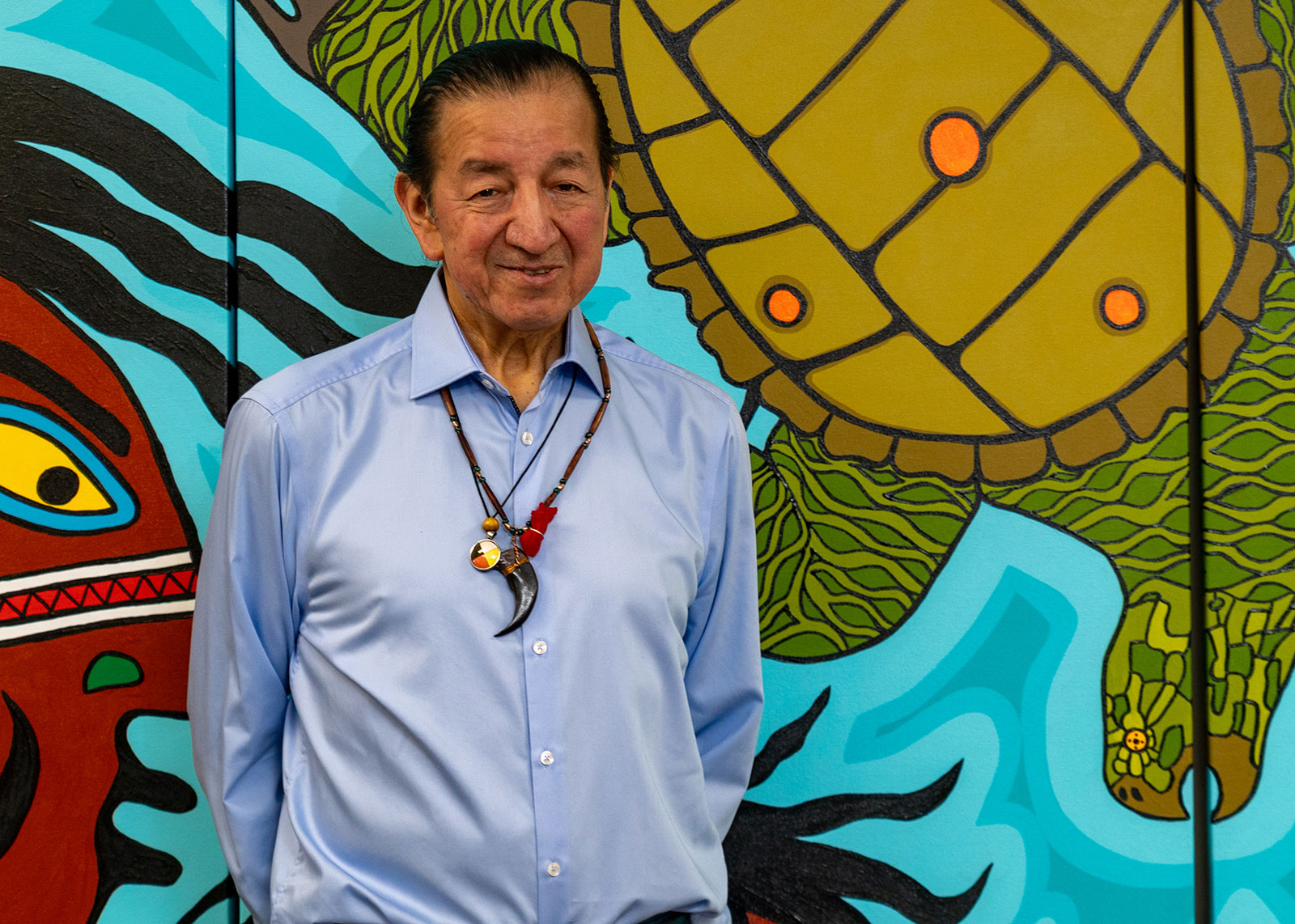
Sacred Circle of Unity was commissioned by UFCW Locals 175 & 633 in partnership with Moccasin Identifier™, as part of the Local Union’s ongoing commitment to reconciliation, Indigenous advocacy, and treaty recognition.
Learn more about UFCW Locals’ 175 & 633 commitment to Indigenous Reconciliation and Advocacy.